Showing posts with label work exchange. Show all posts
Showing posts with label work exchange. Show all posts
Friday, May 17, 2013
Bee Stings and Breakfast

Our eggs florentine turned out perfect for breakfast. (We snuck in a little bacon, too.) And it was a great way to use up some of that garden-fresh spinach.

We served it with homemade toasted bread rubbed with garlic and butter. I am now obsessed with rubbing toast with a fresh clove of garlic. It's so yummy! Apparently this is something they do in Spain. Also, this is one of the many reasons work exchanging is so fantastic---meeting so many different people and seeing how they cook, eat, live, and garden, and just experiencing so many very individualized ways of life. You get exposed to things you might never try otherwise, like the time we helped make sausage in Asheville, or the Korean food we ate here for dinner last night. It's really a top notch way to widen your perspective of the world, even in your own native country.

Kate and I having chocolate bread pudding with butter almond ice cream under the apple tree post-lunch this afternoon, thanks to Nitya from Woodsong Hollow.

Kate and Tom's garden. One of their experiments is a micro-orchard, in the far left of this photo. The fruit trees are spaced about 4 feet apart with large comfrey plants in the intervening spaces. Planting the fruit trees so close together intentionally stunts their growth. You should never need a ladder to pick their fruit or prune, because they will never grow much higher than you can reach. This allows you to have a high variety of different fruits without taking up much space and without having an overabundant harvest.
Using the comfrey is a trick of permaculture, which views everything as a system and looks at how plants can work together to preform functions, like pest control and soil amendments, and mutually benefit each other as well as the whole. Because fruit trees have shallow roots, they need a way to get more nutrients. That's where the comfrey steps in. It has a very deep tap root, so it is able to pull nutrients from under the soil to the top soil layers, where the fruit trees will be able to access and utilize them. Also, they prevent weeds from growing, and their falling leaves provide a mulch at the base of the trees to add more organic matter back into the soil.

This is the moveable chicken coop, currently home to 4 laying hens. It is on 2 back wheels, and can be pulled to a new area of the yard everyday in order to give the chickens fresh organic matter and tasty bugs to nibble as a supplement to their diet. Also, moving them daily prevents them from completely scratching up any one area of the yard.

These bees are from a guy in Vermont who does not medicate and breeds for only the strongest bees. The hive on the right is new as of last week. Unfortunately, they seem to be more aggressive than the older hive. Dave and I have both gotten stung when we were not even working near the hives. Apparently we're the first work exchangers to ever get stung, and Kate herself has only gotten stung 2 or 3 times, so our stings are really odd. Strangely enough, this was my first bee sting! I'm glad it happened now, because I tend to be really sensitive to insect bites and we weren't sure how I would react to a sting. It swelled up to about half the size of a baseball and has been maddeningly itchy, but nothing worse than that. To add my own two cents to the conversation about what holistic bee sting remedies work best, I highly recommend tea tree oil. Though the sting is still very itchy, within 2 hours of the first application, the swelling is completely gone! Tea tree is pretty amazing stuff.
Thursday, May 16, 2013
Bi bim bap on the Homestead
Today is our second day work exchanging with Kate and Tom, who live on a suburban homestead outside of Allentown, PA. Homesteading looks a little different for everyone, but its essential definition is producing as much food from your land and doing as much for yourself as you can...being, to a degree, self-reliant and sustainable. For some people, this means sewing their own textiles, canning, preserving, gardening, keeping a milk goat, or any number of things. It's different from farming in that you are generally producing only for yourself and your family, not for profit.
For Kate and Tom, homesteading means gardening, keeping a store of food, canning, preserving, keeping bees, and keeping a few chickens. Their backyard is only of a moderate size, and they are producing, on average, 600 pounds of food a year. 600 pounds! They are mostly growing herbs and veggies, but also have a few laying hens, and, right now, six meat chicks.

We spent some time today picking spinach from the hoop house greenhouse, which is covered in plastic and lined with mylar in areas. This is designed to maximize daylight in order to extend the growing season. The spinach was planted last year, continued to grow slightly over the winter, and began producing leaves you could harvest earlier this spring. This method is based on a book called the Four Season Harvest by Elliot Coleman if you're interested in finding out more.

We ended up with several pounds of spinach today. We're planning eggs florentine with bacon for breakfast to use some of it up, and then possibly some spinach hummus...yum!

The lettuce crop in the hoop house.

Mojo, part of the family here. He's a great cat.

Brushing olive oil on some homemade bread stuffed with spinach and spices to accompany dinner tonight.

Kate went to culinary school and is an amazing chef. We were treated to her bi bim bap, which is a traditional Korean dish. To prepare it, you stir fry lots of veggies---today's were kohlrabi greens, walking onions, and asparagus straight from the backyard garden---with tons of garlic.

You put the stir fry mixture and a fried egg over a bowl full of sushi rice, then top with shredded carrots, toasted sesame seeds, and Vietnamese or traditional Korean hot sauce. The key is to mix all the ingredients together really well.

It was an incredibly flavorful delight. Thanks Kate!
Monday, May 13, 2013
Wild, Local, Wonderful Food
We're wrapping up our last two days here at WoodSong Hollow Farm, and we begin our next (brief) work exchange Wednesday afternoon. One of my favorite parts about this work exchange has been the intimacy with food. From collecting wild plants for eating to being involved in the process of raising chickens for meat to preparing everything from scratch with organic ingredients to planting and harvesting things from the garden, food has been a big part of this experience.
One of my growing interests is wild edible plants. I've been reading parts of Stalking the Wild Asparagus here, which is a great book about wild edibles, and, as a bonus, the author did much of his living and foraging here in PA, so many of the plants he talks about are literally growing in our backyard.

These are nettles, which you have to collect with a rubber glove because they will "sting" any exposed skin. We harvested the young, tenderest part from the top of the plant. Amazingly, when you put the nettles in something hot, the stinging quality goes away, and they are quite nutritious and very delicious. We added them at the very end of the cooking time for chili and just left them in long enough to wilt, as you would with spinach. They were so tasty!

While we didn't cook with any violets here, I did recently learn that they are edible, medicinal, and growing everywhere! I'd love to make some violet jelly. Apparently a poultice made from them is also a good remedy for headaches.

This is poke weed, which seems to generate a lot of discussion regarding its usability as a food. When it gets this purple color, beware! The plant is poisonous. However, apparently many people eat and love the young green shoots.

Some mushrooms growing in the yard. Non-descript mushrooms like these are difficult to identify without making a spore print.

Grapevines.

We planted potatoes in the garden last weekend using the bucket method. You lay a piece of cardboard down (to control weeds), then put a bucket with the bottom cut out on the cardboard. Put about two small sections of potato with eyes in the bottom and fill with dirt. For these, we used really excellent compost from the local municipal compost center. When the potatoes are ready to be harvested, instead of digging around in the dirt to find them, all you have to do is lift up the bucket, and voila! There are your potatoes. No more loosing half your harvest in the potato hills.

This is one of the brick walls we've worked on since we've been here. And look at how huge that comfrey plant in the herb bed is getting!
P.S: If you found us from our banner on Oliver and Abraham's, welcome, and thanks for visiting! We're excited to have begun a month long sponsorship with Oliver and Abraham's, a blog that's definitely been an inspiration to me and which I always eagerly look forward to reading. :)
Friday, May 10, 2013
Baaaas and Bottles
Today, we went to this gorgeous nearby farm to work.

Isn't it amazing? It's so picturesque. This pond is just perfect.

And then there were the lambs.

A set of triplets is being bottle fed to supplement the amount of milk their mother can produce.

Getting to feed them was such a joy. They latch on to those bottles with some serious strength and eagerness!


Me with Sherry, the farm's owner and loving caretaker of all these wonderful creatures.

For work, Dave was in charge of hauling out layers of old hay from the barn floor and driving it up to this pile with the tractor.

I was in charge of weeding a perennial bed. It's funny, I used to be so squeamish of bugs, but all this recent weeding and digging around in the dirt has brought me a new appreciation of them. I love finding all the earthworms and slugs, and was especially excited about this little guy. What a great bug. He curled right up into a ball when I disturbed the dirt around him, but once I left him alone for a while, he uncurled and looked for some new dirt to burrow into. Finding bugs like this in the dirt makes me feel like Alice in Wonderland.

Tonight we have our bedroom window open and we're listening to the rain. What a lovely day. Tomorrow is our day off, and if the rain clears up, we have plans for canoeing and picture taking!
Thursday, May 9, 2013
Alfred Gets his Crow Back!

This is Plucky. We isolated her from the other chickens because she was inexplicably molting (loosing all her feathers) in the spring instead of the fall and in the process was getting pecked by the other chickens. They're growing back now, and she's looking much better. Shawn, the newest work exchanger on the farm, is in the background.

This is Alfred, who is also isolated from the other chickens along with Plucky. A few weeks ago, he was depressed and laying in the corner of the barn all the time. He used to be top rooster, but got into a fight with the other rooster and lost vision in one of his eyes. The hens then all accepted the other rooster as top bird. Alfred was very sad. Now, though, he's doing so much better, and follows us around crowing all day. It's the most adorable thing.
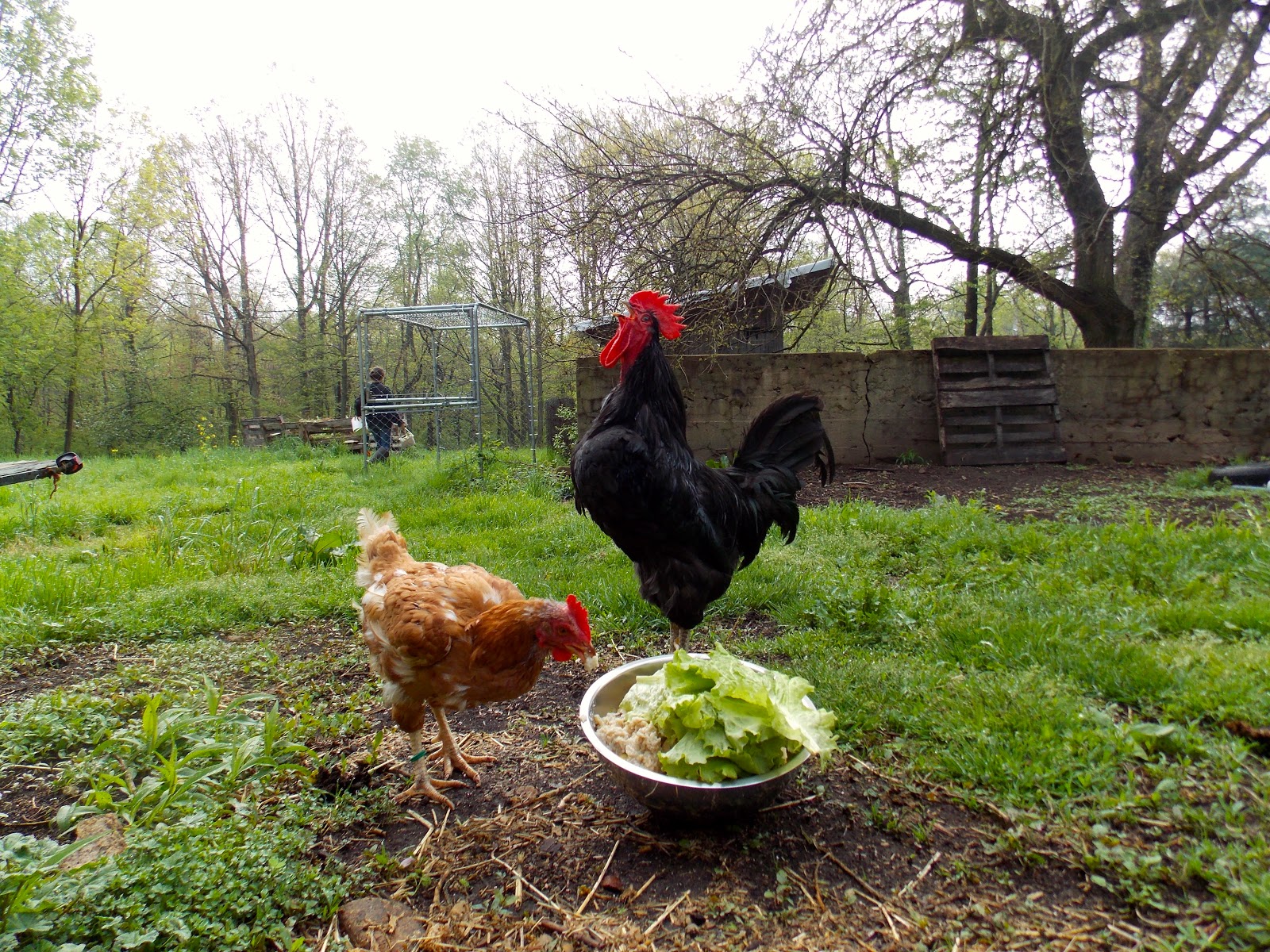
It's been neat hearing Alfred get his voice back. A few weeks ago, he didn't crow at all, and when he started crowing again, it was timid and on the quiet side. Not any more! Alfred loves to tell us good morning.


The chickens love leftover veggie scraps, especially lettuce. It's one of their favorites, along with strawberries, pears, and tomatoes.

Dave sharpened this scythe with a whetstone and used it to cut a long swath through waist high grass in a field before we moved an electric fence we use to keep predators away from the meat chicks.

Dave and I moved the electric fence and set it back up all by ourselves. It was cool to use the skills we've learned and know things have actually stuck in our memory.

After one of his runs, Jeff brought back a morel mushroom he found, and we cooked it up for all four of us to share. It might have only been two bites each, but it was delicious! No wonder they fetch such a high price per pound. (It is very hard to cultivate them, so the only way to obtain these mushrooms is to forage them in the wild during a specific period of the year.)

The gorgeous redbud tree by the barn.
Tomorrow, we're going to a nearby farm to do some paid work, which is really awesome. Then, just three more work days here at WoodSong Hollow before we move on to our next work exchange, which is also nearby, for a week. Time flies!
Monday, May 6, 2013
Spring Time Transitions
One of the neat things about being here at WoodSong Hollow during this time of year has been helping the farm make its transition from Winter into Spring. Part of this process has been moving the laying hens from the barn out into the field, which we finished last week.

This is the egg mobile. It is on wheels and hitches to the back of a truck to be moved from place to place. It is the chicken's shelter and includes their nest boxes, food, and water. The idea behind it is that it allows you to move your chickens to different places so they can help you with scratching up weeds (especially the garlic mustard here!) and fertilizing the soil. You can set up as large or as small of an electric fence perimeter around it as you'd like, giving your chickens plenty of room to roam while keeping them protected from predators like foxes. When they've dug around for a while, you can re-hitch the egg mobile to the truck and move them and the fencing to another spot.

The chickens are quite happy with this arrangement, and very pleased to be out of the barn after the winter.

Dust baths are the best!


We found two mice who had made their way into a feed sack at the bottom of a barrel, which is impossible for them to climb out of. A few of their friends clearly hadn't made it, but we were able to let these guys out into the wild, making for some very happy mice.

The chicks have grown so much since we've been here! That's been another neat thing about staying for a month...getting to see the chicks grow along with all the other springtime farm transitions.
P.S: If you're new to our blog or just curious, we've made some updates to our About page. Check it out here!
Saturday, May 4, 2013
A Drive Through Amish Country
Today (after our usual Saturday morning yard sale-ing) we went for a drive through Lancaster County, PA, where there are tons of Amish and Mennonite farms.

The amount of farm land in this area is staggering. We were not expecting it to be this vast.

We drove for miles and miles past nothing but farms like these.

Lancaster County is also known for its huge number of thrift stores. There are so many they actually have a brochure directory to list them all! We enjoyed spending the afternoon thrifting, and came away with some cool purchases. Another 60 pounds of weight was all we needed to add to the van, but we discovered a trove of Horizon magazines, which were published from the 1950's to the 1980's in a really nice hardback format. We got 45 of them for $19! It was a deal we couldn't pass up. We'll definitely be storing these at my parents house so we can display and enjoy them in our own place after our travels.

Mamma and baby horse.


It was really neat to see all the Amish and Mennonites traveling down the main roads in their horse drawn buggies. It was like being in a different time period.


Happy weekend to you!
Subscribe to:
Posts
(Atom)


